FMEA Standards: AIAG & VDA, IEC 60812, and Industry Requirements
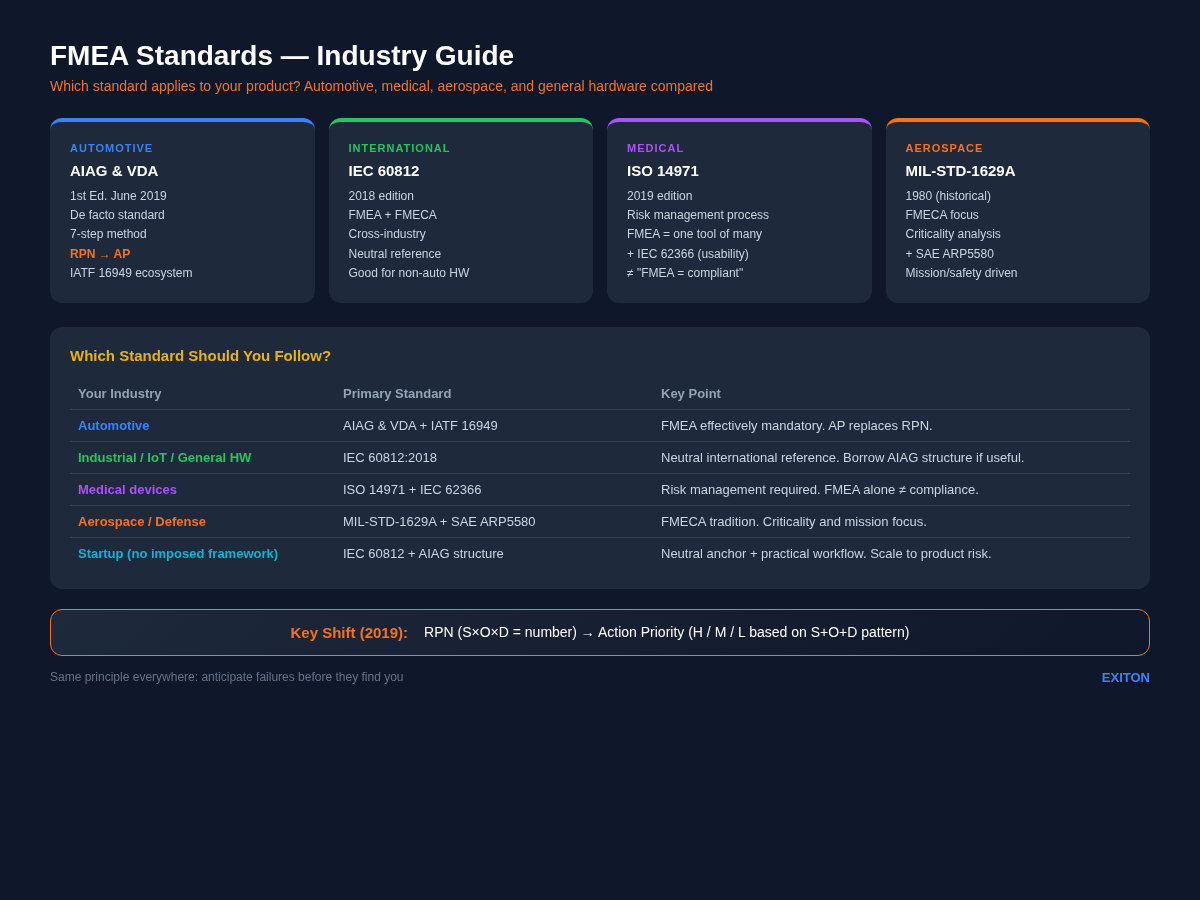
A Brief History of FMEA Standards
FMEA has been around far longer than many engineers realize.
The method took shape in high-reliability sectors such as aerospace and defense, where teams needed a formal way to analyze how failures could affect mission success, safety, and maintainability. One of the historically important documents in that lineage is MIL-STD-1629A, formally titled Procedures for Performing a Failure Mode, Effects and Criticality Analysis, issued on 24 November 1980. It is an old document, but still historically important because it shaped how many engineers think about FMECA and criticality analysis.
Over time, FMEA spread beyond defense and into automotive, industrial systems, electronics, medical devices, and many other fields. As that happened, industries began to adapt the method to their own needs. Automotive organizations pushed toward supplier-friendly structured workflows. International standards bodies documented broader generic FMEA/FMECA methods. Medical-device standards incorporated risk-management processes where FMEA could be one tool among several. Aerospace kept stronger continuity with criticality-driven traditions.
So there is no single universal "FMEA law" that all industries follow in exactly the same way. There are instead families of standards and guidance documents, and your job is to follow the one that matches your industry, customers, and regulatory context.
AIAG & VDA FMEA Handbook (1st Ed. 2019) — The Current De Facto Standard
For automotive product development, the most important current reference is the AIAG & VDA FMEA Handbook, First Edition, issued June 2019. It was jointly developed to harmonize the older AIAG and VDA approaches into a single method that suppliers and OEMs could use more consistently. The handbook itself explains that it is a reference manual intended to guide the development of Design FMEA, Process FMEA, and Supplemental FMEA for Monitoring and System Response; it explicitly says it does not define requirements by itself.
That distinction matters. The handbook is not a regulation. It is not a law. But in real automotive work, it has become the de facto standard reference for modern FMEA practice because customers and suppliers increasingly expect the harmonized method.
One reason the 2019 edition matters so much is that it replaced the old split between AIAG FMEA 4th Edition (2008) on one side and VDA Volume 4 style expectations on the other. The integrated handbook gives teams one common structure and vocabulary.
The most important practical shift in the 2019 handbook is the move away from treating RPN as the main prioritization logic. Instead, the handbook emphasizes Action Priority (AP). That was not a cosmetic change. It reflects a real methodological improvement: different Severity/Occurrence/Detection combinations can have the same RPN while implying very different engineering urgency. AP is meant to better represent that practical reality.
The AIAG & VDA approach also formalizes a 7-step method, typically summarized around planning/preparation, structure analysis, function analysis, failure analysis, risk analysis, optimization, and documentation of results. Even outside automotive, this structure is useful because it enforces traceability and discourages the "random spreadsheet filling" style of FMEA that wastes everybody's time.
If you want the conceptual intro first, see What is FMEA? A Practical Guide for Hardware Engineers. If you want the implementation flow, see How to Create a DFMEA: Step-by-Step Guide with Examples.
IEC 60812 — International Standard for FMEA/FMECA
If AIAG & VDA is the automotive practical reference, IEC 60812:2018 is the broader international standard for FMEA and FMECA.
Its formal scope is to explain how FMEA, including the FMECA variant, is planned, performed, documented, and maintained. The standard's purpose is to establish how items or processes might fail to perform their function so that appropriate treatments can be identified. That makes IEC 60812 a good general-purpose anchor when you are outside automotive-specific customer expectations or when you want a more cross-industry reference point.
IEC 60812 is not an automotive-only document, and that is one of its strengths. It is useful across industrial equipment, electronics, infrastructure systems, process applications, and other engineering domains where a structured failure analysis is needed.
It also explicitly includes FMECA, which matters in sectors that care deeply about criticality and not just failure listing.
A practical way to think about the relationship is: AIAG & VDA = automotive-oriented best-practice handbook for today's supplier ecosystem. IEC 60812 = broader international FMEA/FMECA methodology standard.
If your team is building non-automotive hardware and your customer is not demanding the AIAG & VDA structure, IEC 60812 may be the cleaner neutral reference. If your customer is an automotive OEM or Tier 1, AIAG & VDA is usually the more relevant working language.
Automotive Requirements (IATF 16949)
In automotive, the most important quality-management framework is IATF 16949:2016.
Automotive organizations are expected to perform risk-based quality and product-development activities, and FMEA is deeply embedded in that ecosystem. Customer-specific requirements and supplier-development expectations often make FMEA effectively mandatory in day-to-day automotive work, even when a single clause does not say "use this exact worksheet format."
This is why many engineers say, in plain language, that FMEA is mandatory in automotive. That is directionally true in practice. If you are developing automotive products under IATF-oriented expectations, you should assume that some form of formal FMEA activity is required, and that AIAG & VDA is the most likely expected reference.
A useful distinction: IATF 16949 sets the quality-management and risk-based framework. AIAG & VDA FMEA Handbook provides the practical modern method many automotive teams use to execute FMEA.
So the question is usually not "Do we need FMEA?" It is "How do we perform and maintain FMEA in a way customers will accept?"
Medical Device Requirements (ISO 14971, IEC 62366)
Medical devices work differently.
The central standard is ISO 14971:2019, formally Medical devices — Application of risk management to medical devices. Importantly, ISO 14971 does not require FMEA specifically. It requires a risk-management process. FMEA is one possible technique within that broader framework.
That distinction is crucial. In medical devices, saying "we did an FMEA" is not the same thing as saying "we satisfied all risk-management obligations." FMEA may support the work, but the governing expectation is the broader risk-management process defined by ISO 14971.
Another important document is IEC 62366-1:2015 (and its amended form IEC 62366-1:2015+A1:2020), which specifies a usability engineering process for medical devices as it relates to safety. This matters because some critical risks in medical devices are use-related rather than purely hardware-failure-related.
For medical devices, the right mental model is: ISO 14971 = mandatory risk-management backbone. IEC 62366-1 = usability / human-factors safety process. FMEA = often useful, but only one tool in the larger system.
Aerospace & Defense (SAE ARP5580, MIL-STD-1629)
Aerospace and defense have their own FMEA/FMECA history and vocabulary.
On the historical side, MIL-STD-1629A remains the classic reference many engineers still recognize. Its full title is Procedures for Performing a Failure Mode, Effects and Criticality Analysis, and it explicitly frames FMECA as a formal method for evaluating impacts on mission success, personnel and system safety, performance, maintainability, and maintenance requirements.
On the more modern side, SAE ARP5580 provides recommended FMEA practices for non-automobile applications. SAE describes it as intended for organizations whose development processes use FMEA as a tool for assessing safety and reliability.
So in aerospace and defense, you will often see stronger continuity with FMECA and criticality-oriented traditions than in mainstream commercial electronics.
Which Standard Should You Follow?
Here is the practical version.
If you are in automotive — Follow expectations from IATF 16949 and customer-specific requirements, and use AIAG & VDA FMEA Handbook (2019) as your main working reference unless your customer explicitly requires something else.
If you are in general industrial / electronics / non-automotive hardware — Use IEC 60812:2018 as the neutral international reference. If your customers already speak AIAG & VDA, using that structure may still be practical.
If you are in medical devices — Start with ISO 14971:2019 as the governing risk-management framework. Use FMEA as a technique where appropriate, but do not confuse "completed FMEA" with "completed risk management." Also check IEC 62366-1 for use-related hazards.
If you are in aerospace or defense — Expect stronger use of FMECA, historical continuity with MIL-STD-1629A, and possible relevance of SAE ARP5580.
If you are a startup with no imposed framework — A practical answer: (1) use IEC 60812 for a neutral standard anchor, (2) borrow the AIAG & VDA structure for an operational workflow, (3) tailor the level of formality to product risk, not to your appetite for bureaucracy.
And for getting started quickly, use a standards-aligned FMEA template.
The big picture is simple: the principles of FMEA are broadly similar everywhere, but the governing framework depends on industry context.
FAQ
Q: What is the current automotive standard for FMEA?
A: The main current reference used in automotive practice is the AIAG & VDA FMEA Handbook, First Edition, issued June 2019. It has become the de facto standard working method in many automotive organizations.
Q: What is IEC 60812?
A: IEC 60812:2018 is the international standard that explains how FMEA and FMECA are planned, performed, documented, and maintained.
Q: Is FMEA required by IATF 16949?
A: In practical automotive work, yes. Formal FMEA activity is generally expected as part of the quality and product-development ecosystem.
Q: Does ISO 14971 require FMEA?
A: Not specifically. ISO 14971:2019 requires a risk-management process for medical devices. FMEA can be one tool used within that process, but it is not the only acceptable method.
Q: Is RPN still the current recommended approach?
A: For modern automotive-oriented FMEA, the major shift in the AIAG & VDA 2019 handbook is from relying mainly on RPN toward using Action Priority (AP).
Try EXITON FMEA — Free for 30 Days
Generate AIAG & VDA compliant DFMEA from your schematic. No credit card required.
Download Free Trial