What is FMEA? A Practical Guide for Hardware Engineers
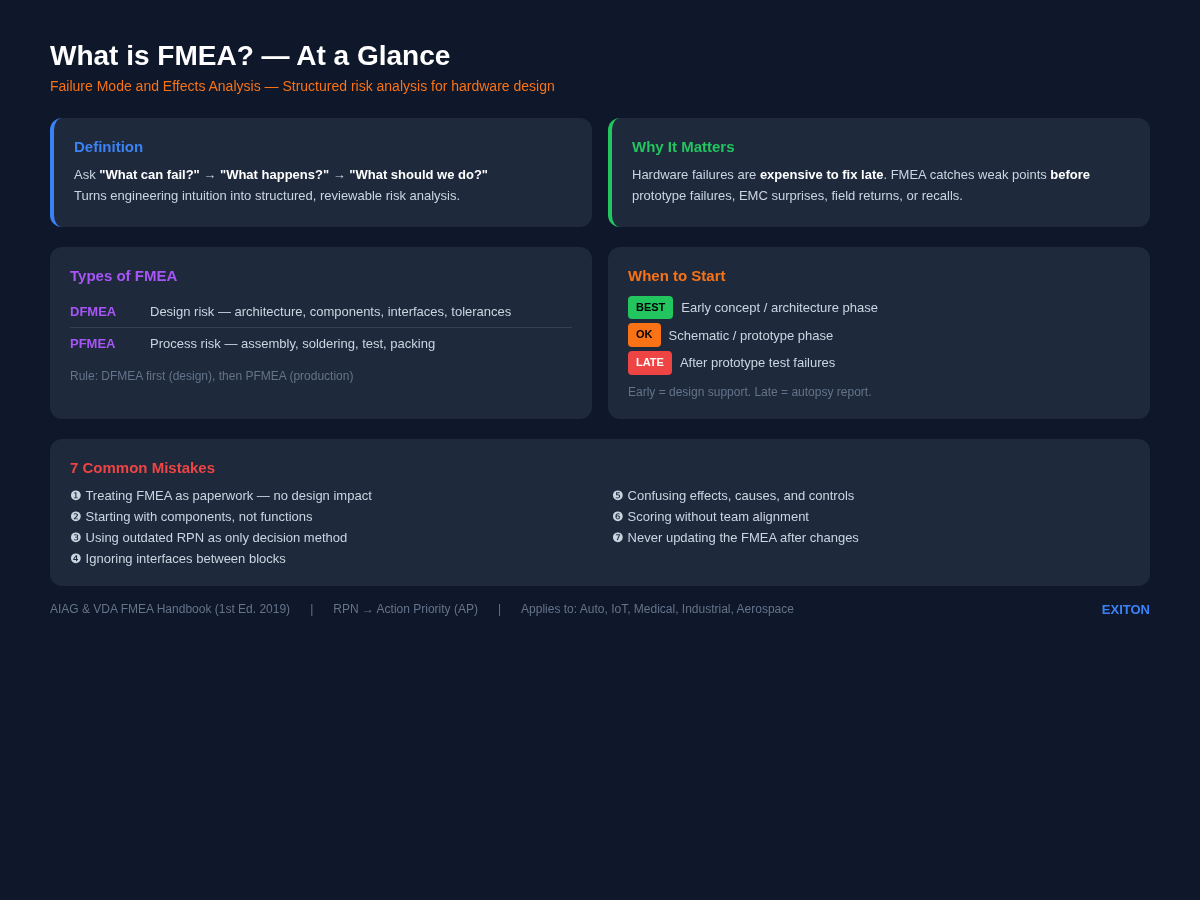
Definition — What Does FMEA Stand For?
FMEA stands for Failure Mode and Effects Analysis.
That sounds formal, but the idea is simple: you look at a product or process, ask "what can fail?", then ask "what happens if it does?", and finally decide what you should do about it before it becomes a field problem.
If you build hardware, you already do parts of this in your head. You know a pull-up resistor can open. You know a connector can loosen. You know a sensor can drift, and the ADC will happily convert nonsense into a very confident wrong number. FMEA is the method that turns that engineering intuition into a structured risk analysis that a team can review, improve, and reuse.
A good FMEA is not a spreadsheet ritual. It is a design conversation with receipts.
The term "failure mode" means the way something fails. The "effects" are what that failure does at the local, subsystem, or end-user level. The "analysis" part is where you evaluate risk, identify controls, and define actions.
Modern FMEA practice in many industries—especially automotive—has been strongly shaped by the AIAG & VDA FMEA Handbook, First Edition, issued June 2019, which formalized a 7-step approach and pushed teams away from relying only on the older RPN method.
Why FMEA Matters in Hardware Design
Hardware failures are expensive in a way software engineers sometimes underestimate.
If a firmware feature is buggy, you may be able to patch it remotely. If a resistor value was wrong, a thermal margin was too thin, or a sensor fault path was missed, you may be dealing with rework, returns, recalls, production delays, or worst of all, a safety incident. The earlier you catch a failure mechanism, the cheaper it usually is to fix.
That is why FMEA matters. It helps teams find weak points before prototype test failures, EMC surprises, field returns, or customer complaints do the teaching for them.
This is not only an automotive issue. The same logic applies across:
- IoT devices that live in noisy power environments
- Consumer electronics where cost pressure tempts away robustness
- Industrial equipment that must tolerate temperature, vibration, and misuse
- Medical devices where risk analysis is tightly connected to patient safety
- Aerospace and defense systems where criticality and mission impact dominate the discussion
In practice, FMEA gives you a few very concrete benefits:
- It forces the team to define system boundaries and interfaces clearly
- It surfaces hidden assumptions early
- It makes failure logic visible across hardware, software, mechanical, and manufacturing teams
- It helps prioritize engineering effort instead of treating all risks as equally urgent
- It leaves behind a reusable risk knowledge base for the next design revision
And yes, it can feel tedious. No engineer wakes up excited to color cells in a worksheet. But the uncomfortable truth is this: FMEA is usually less painful than debugging preventable failures after release.
Types of FMEA (DFMEA vs PFMEA)
When engineers say "FMEA," they usually mean one of two big categories: DFMEA or PFMEA.
DFMEA: Design Failure Mode and Effects Analysis
DFMEA focuses on the design itself. You ask what can go wrong because of the product architecture, component selection, interfaces, tolerances, environmental stress, logic assumptions, or misuse conditions.
Examples:
- Thermistor open circuit causes ADC to read full-scale
- Reverse polarity protection is inadequate for real-world wiring mistakes
- Insufficient decoupling causes brownout resets during load transients
- Mechanical housing allows moisture ingress near a connector
DFMEA is the tool you use when you are designing the thing.
PFMEA: Process Failure Mode and Effects Analysis
PFMEA focuses on how the product is made, assembled, tested, packed, or serviced. Here the question is not "is the schematic sound?" but "what can go wrong in the process that produces this product?"
Examples:
- Wrong resistor loaded on the SMT line
- Solder voids reduce thermal reliability
- Torque on a connector is inconsistent
- Final test fixture misses intermittent faults
PFMEA is the tool you use when you are producing the thing.
So which one comes first?
For hardware startups, DFMEA usually deserves attention first, because a clean manufacturing process cannot save a weak design. But once you move toward production, PFMEA becomes equally important. A product can be well designed and still fail in the field because the build process is unstable.
If you want the practical how-to, see How to Create a DFMEA: Step-by-Step Guide with Examples.
When to Start FMEA in Your Design Process
The short answer: earlier than you think.
A lot of teams start FMEA too late—after the architecture is frozen, after the schematic is mostly done, or after the first prototype already exposed the obvious weaknesses. At that point, FMEA becomes documentation of problems you already found the hard way.
That is backwards.
The best time to start DFMEA is during early design definition, when you still have freedom to change boundaries, architecture, component strategy, interfaces, and assumptions. The 2019 AIAG & VDA approach is built around a front-loaded flow: planning and preparation, structure analysis, function analysis, failure analysis, risk evaluation, optimization, and documentation. That only works well if the analysis starts while design decisions are still fluid.
A practical timing model for a hardware team looks like this:
Early concept phase
Use lightweight FMEA thinking to define scope, system boundaries, and top-level functions.
Architecture and schematic phase
This is where DFMEA becomes really useful. You know enough to analyze functions and interfaces, but you still have room to change design choices.
Prototype and validation phase
Update the FMEA with actual findings. At this stage, FMEA should not be written from scratch. It should be refined using real evidence.
Pre-production
Use the updated DFMEA to support control plans, validation decisions, design reviews, and handoff into PFMEA.
If you wait until the end, the FMEA becomes an autopsy. If you start early, it becomes design support.
Common Mistakes Engineers Make with FMEA
1. Treating it as paperwork
This is the classic failure mode of the failure analysis method.
Teams copy an old worksheet, rename the product, fill in generic phrases like "part failure," and call it done. The output looks official, but it does not change design decisions. A good FMEA is specific. It names real functions, real failure modes, real effects, and real controls.
2. Starting with components instead of functions
A weak FMEA says, "R12 open." A stronger FMEA says, "the voltage divider no longer scales the sensor signal correctly, causing the ADC input to saturate."
Why does that matter? Because failures should be connected to function, not just inventory. Otherwise you miss system context and duplicate analysis everywhere.
3. Using outdated RPN logic as the only decision method
Older FMEA practice often emphasized multiplying Severity × Occurrence × Detection into a single RPN number. The problem is that very different risk patterns can collapse into the same score, and high-severity issues can be hidden by arithmetic. The AIAG & VDA 2019 approach instead emphasizes Action Priority (AP) to guide whether action is strongly recommended, recommended, or lower priority.
4. Ignoring interfaces
Many ugly failures happen between blocks, teams, or assumptions: sensor output range vs ADC input range, power sequencing between ICs, connector pinout vs harness behavior, firmware assumptions vs analog reality.
If your FMEA only looks inside each component and not at the interfaces, you are inspecting the bricks while ignoring the cracks in the wall.
5. Confusing effects, causes, and controls
This happens constantly. Failure mode: thermistor open. Effect: false high-temperature alarm. Cause: solder crack, wire break, connector fatigue. Current control: ADC plausibility check, end-of-line continuity test.
If a worksheet mixes these up, the whole analysis gets muddy fast.
6. Scoring without team alignment
Occurrence and detection scores are not magic numbers sent from heaven. They depend on common criteria. If one engineer scores based on lab prototypes and another scores based on field exposure at scale, the worksheet becomes numerology. The scoring basis must be aligned before the ratings mean anything.
7. Never updating the FMEA
A frozen FMEA is often a dead one. If design changes, validation finds new behavior, or field returns reveal new causes, the FMEA should change too. A good FMEA is a living engineering artifact, not a PDF fossil.
For the standards background behind modern FMEA practice, see FMEA Standards: AIAG & VDA, IEC 60812, and Industry Requirements.
FAQ
- Q: What is FMEA in simple words?
- A: FMEA is a structured way to think through how a product or process can fail, what the consequences are, and what actions should be taken to reduce risk.
- Q: What does FMEA stand for?
- A: FMEA stands for Failure Mode and Effects Analysis.
- Q: Is FMEA only for automotive companies?
- A: No. FMEA is heavily used in automotive, but the method is also useful in IoT, industrial equipment, consumer electronics, medical devices, aerospace, and many other engineering fields.
- Q: What is the difference between DFMEA and PFMEA?
- A: DFMEA analyzes risks in the product design. PFMEA analyzes risks in the manufacturing or assembly process.
- Q: Is RPN still used in FMEA?
- A: You will still see RPN in older templates and legacy workflows, but modern automotive practice has shifted toward Action Priority (AP) as described in the AIAG & VDA FMEA Handbook (2019).
Try EXITON FMEA — Free for 30 Days
Generate AIAG & VDA compliant DFMEA from your schematic. No credit card required.
Download Free Trial