DRBFM vs FMEA: Which Should You Use?
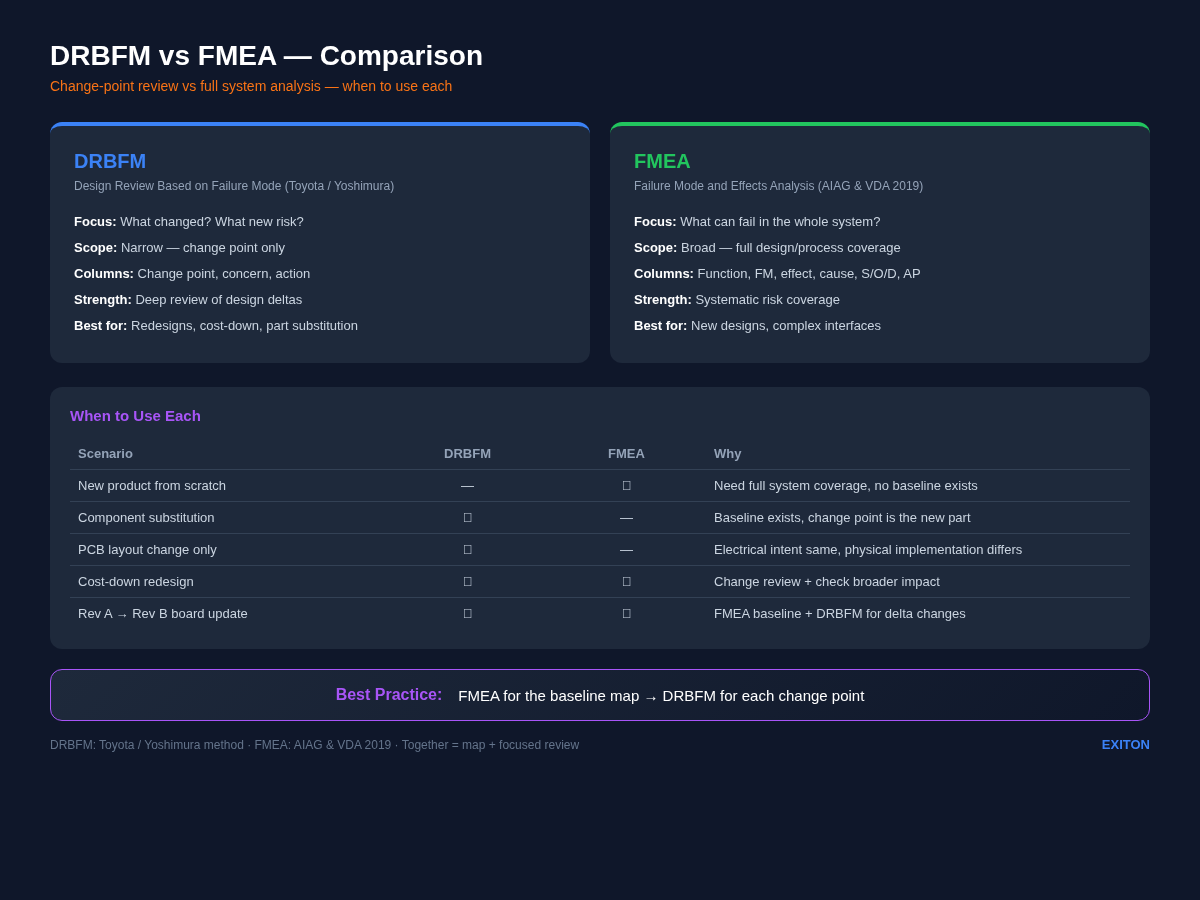
What is DRBFM? (Origin: Toyota / Yoshimura method)
DRBFM stands for Design Review Based on Failure Mode.
At a practical level, DRBFM is a review method for design changes. Instead of asking a broad question like "what could fail anywhere in this system?", DRBFM asks a narrower and more useful question for redesign work: "what changed, what worries us because of that change, and what should we do about it?" That focus is the whole point.
DRBFM is widely associated with Toyota and with Tatsuhiko Yoshimura, who developed the methodology around the idea that many design problems are introduced when teams change an already working design without fully exploring the consequences. In other words: the old design was fine until someone "just changed one small thing." Engineers have heard that sentence before. Usually right before a long night.
The Yoshimura/Toyota philosophy behind DRBFM is often summarized as focusing deep review energy on the change point. The method is not trying to replace engineering judgment with a giant worksheet. It is trying to force the right conversation at the right place: the place where the design is no longer the same as the one that was already proven.
That is why DRBFM is especially attractive for hardware teams working on:
- cost-down redesigns
- alternate component substitutions
- PCB layout changes
- connector changes
- enclosure or thermal path revisions
- firmware assumptions changing around existing hardware
- "minor" updates that are not minor at all once they hit the field
If you need the broader foundation first, read What is FMEA? A Practical Guide for Hardware Engineers.
Key Differences Between DRBFM and FMEA
The simplest way to understand the difference is this:
FMEA asks: "What can fail in this design or process?"
DRBFM asks: "What changed, what new concerns does that change create, and what should we review because of it?"
That sounds subtle, but in practice it changes everything.
FMEA is broad and systematic — FMEA is built for structured, relatively comprehensive risk analysis. In modern practice, especially around the AIAG & VDA 2019 handbook, it follows a structured path from system structure to functions, failure modes, effects, causes, controls, and action priority. It is meant to cover the design or process in a traceable way.
DRBFM is narrow and change-focused — DRBFM is built for reviewing design deltas. It assumes you are not starting from nothing. You already have an existing design, and the real engineering risk lies in the fact that something has changed. The worksheet and review discussion therefore center on the changed item, the concerns raised by that change, and the countermeasures or validation needed.
FMEA is good at coverage — If you are designing a product from scratch, you need a method that forces you to think systematically about structure, function, failure, and risk. FMEA is stronger here because it gives you a disciplined way to avoid blind spots across the whole system.
DRBFM is good at design-change realism — If you are revising an existing product, the risk is often not "the whole product may fail in every possible way." The risk is that a local change introduces a side effect somewhere the team did not revisit. DRBFM is tuned for this.
Their worksheets feel different — A typical FMEA worksheet includes: function, failure mode, effect, cause, prevention/detection controls, risk evaluation such as AP. A DRBFM worksheet tends to center on: change point, concern/worry point, potential failure consequence, review result/action.
For the practical FMEA workflow, see How to Create a DFMEA: Step-by-Step Guide with Examples.
When to Use DRBFM (Change-Point Focus)
Use DRBFM when the design already exists and the key engineering question is what this change might break.
Typical cases:
1. Component substitution — A part goes obsolete. You replace it with a "drop-in equivalent." On paper the electrical specs look close enough. In reality, leakage, tolerance, startup behavior, EMC sensitivity, or long-term drift may not be close enough. The original design may have been fine. The change point is the new part. The review should focus there.
2. PCB layout change without schematic change — "Nothing changed electrically" is a dangerous sentence when return current paths, coupling, thermal spreading, creepage, or sensor routing have changed. DRBFM is useful here because the design intent may be the same while the physical implementation is not.
3. Cost-down redesign — Cost-down changes are exactly where hidden reliability losses like to live. Smaller margins, cheaper components, different suppliers, thinner copper, reduced filtering. DRBFM forces the uncomfortable question: What did we just weaken without admitting it?
4. Minor firmware or calibration updates around existing hardware — DRBFM thinking is useful when code changes alter assumptions around hardware behavior: new sensor plausibility logic, changed ADC filtering, updated thermal thresholds, revised fault handling.
5. Late-stage design tweaks — The later the change, the more valuable a focused review becomes. At that point, schedules are tight and people are tired, which is exactly when "small change, probably okay" becomes a corporate folk tale and then a warranty budget.
When to Use FMEA (Full System Analysis)
Use FMEA when you need a broader and more structured analysis of the design or process as a whole.
New product development — If you are creating a fresh hardware design, you need more than change review. You need a method that forces you to define structure, functions, failure modes, effects, causes, and controls from the ground up. FMEA is built for that. The AIAG & VDA handbook's 7-step structure is especially useful.
Complex systems with many interfaces — FMEA is stronger when you need to analyze interactions among sensors and signal conditioning, power rails and brownout behavior, mechanical interfaces, environmental stress, diagnostics and detection strategy.
Process planning and production readiness — If the issue is not just design risk but also manufacturing or assembly risk, then PFMEA becomes important too. DRBFM is not a substitute for that.
Building a reusable risk knowledge base — FMEA leaves behind structured engineering knowledge that is reusable for future revisions, audits, handoffs, and derivative designs.
Simple rule: New design or full risk coverage needed → use FMEA. Existing design plus meaningful change → use DRBFM.
Can You Use Both Together?
Yes — and in many real engineering teams, that is the best answer.
The most practical relationship is: FMEA for the baseline, DRBFM for the change.
The FMEA gives you the structured map of functions, risks, and controls. The DRBFM then zooms in on what changed from that baseline and asks whether the old assumptions still hold.
This combined approach is especially useful in hardware teams that regularly revise products over time: Rev A to Rev B board updates, sensor substitutions, enclosure revisions, alternate sourcing changes, regional or regulatory variants, cost-down iterations after launch.
Without FMEA, DRBFM can become too narrow and miss broader system context. Without DRBFM, FMEA updates for redesign work can become too generic and fail to stress the actual change point. Together, they cover both the map and the fresh pothole.
For readers who want the full FMEA foundation, start with What is FMEA? A Practical Guide for Hardware Engineers, then move to How to Create a DFMEA: Step-by-Step Guide with Examples.
FAQ
Q: What is DRBFM in simple terms?
A: DRBFM is a method for reviewing design changes. It focuses on what changed, what concerns that change creates, and what actions or validation are needed.
Q: Who created DRBFM?
A: DRBFM is widely attributed to Tatsuhiko Yoshimura and is closely associated with Toyota's design-review culture.
Q: What is the main difference between DRBFM and FMEA?
A: FMEA is broader and more systematic for full design or process risk analysis. DRBFM is narrower and focuses specifically on risks introduced by changes to an existing design.
Q: Should I use DRBFM instead of FMEA?
A: Usually not as a full replacement. DRBFM is best for design changes. FMEA is better for complete design or process risk coverage.
Q: What is the best practical rule?
A: New design → FMEA. Design change → DRBFM. High-stakes change on an existing design → both.
Try EXITON FMEA — Free for 30 Days
Generate AIAG & VDA compliant DFMEA from your KiCad schematic. No credit card required.
Download Free Trial